Books for Building AI Agents in 2026
Five books for engineers building agents, scored on four dimensions against their tables of contents and code repositories. Includes what each one is not for.
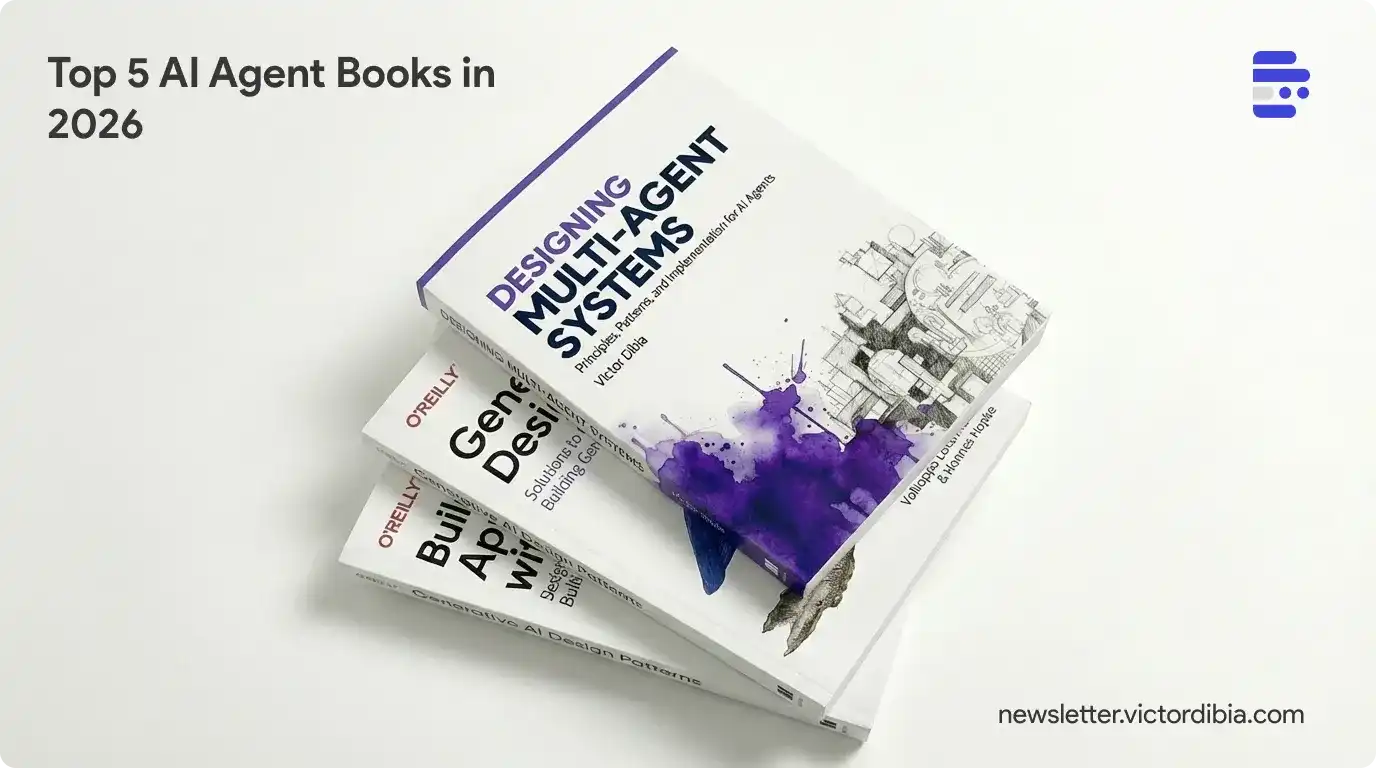
AI Agents are now a staple part of how software is built. With tools like Claude Code from Anthropic, Codex from OpenAI, it is now possible to author and review complex software functionality with almost no effort. Arguably, understanding how these agents work, and building the right intuition on how and when to use them is critical for software engineers. In this post, I'll cover 5 books that are helpful to build this intuition.
Each book is scored 1–5 on how much it covers agent concepts, multi-agent patterns, hands-on implementation and UX — and every score cites what it was read from, so you can check it.
Designing Multi-Agent Systems
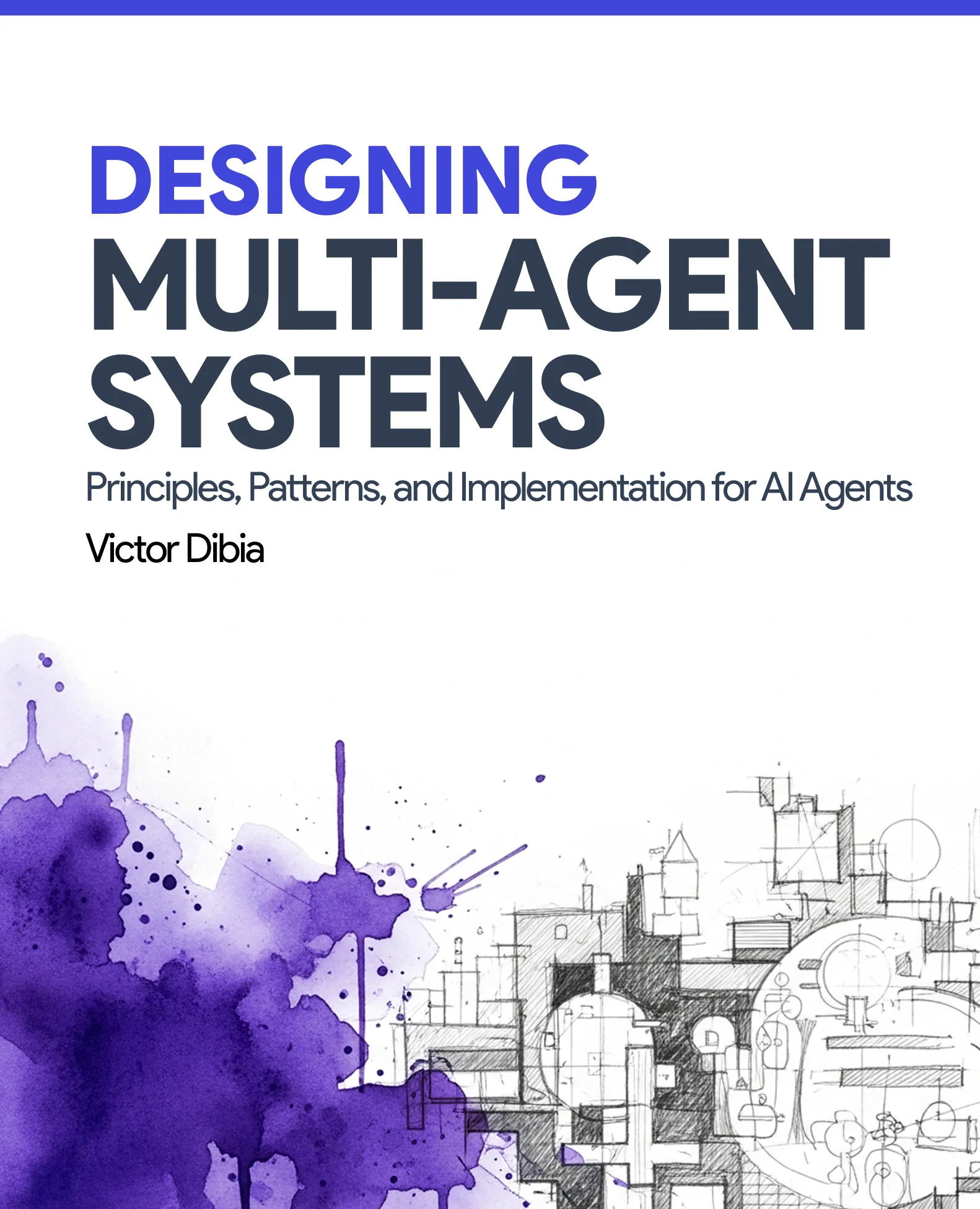
Designing Multi-Agent SystemsMy book
15 chapters across 4 parts teaching multi-agent systems from first principles. Part I covers theory (patterns, UX principles). Part II guides the reader through building a full featured but hackable multi-agent framework called - PicoAgents - from scratch. Spefically, you build an agent class (add model clients, tool calling, middleware, observability with opentelemetry, human input and approvals, agents as tool), extend it to build a computer use agent, builld multi-agent workflows, orchestration, and learn to integrate these into a web application. Part III covers evaluation, optimization, protocols (MCP/A2A), and ethics. Part IV provides full case studies (you build a multiagent workflow for structured data analysis and a software engineering agent). The GitHub repo also contains examples of the same concepts implemented using the Microsoft Agent Framework (successor to AutoGen and Semantic Kernel), Goole ADK, and LangGraph.
276 code files (262 .py, 14 .ipynb) — GitHub repo analysis (Nov 2025)
In Designing Multi-Agent Systems, you'll take a first principles approach to learn to design and implement reliable, agentic applications from scratch, understand why their architectures work, and master patterns for collaboration, observability, interruptibility, and trust. These principles remain useful as the ecosystem evolves, giving you the tools to build scalable, robust, and human-centered agentic systems, whether in research or production.
Inside, you’ll explore:
- Multi-Agent Fundamentals — Core concepts and design patterns for multi-agent collaboration
- Build from Scratch — Step-by-step guidance for implementing agents, tools, as well as deterministic workflows and autonomous orchestration patterns.
- Evaluation & Reliability — Learn trajectory-based testing, structured outputs, observability, and performance metrics to ensure agents behave predictably.
- UX and Trust Principles — Apply human-centered design principles like interruptibility, capability discovery, and transparent decision-making to build agents users can rely on.
- Distributed Agent Protocols — Learn how protocols like MCP and A2A build enable distributed multi-agent systems that operate across networks, regions, and organizations.
15 chapters covering agent execution loop, tools, memory, middleware, computer use agents, evaluation trajectories, optimization strategies, and distributed protocols (MCP, A2A).
TOC: 4-part structure with 15 chapters all agent-focused
Ch2 provides full taxonomy: deterministic (sequential, conditional, parallel, supervisor) and autonomous (plan-based, handoff, conversation-driven). Ch6-7 implement each pattern from scratch.
TOC: Ch2 taxonomy, Ch6-7 implementation
Builds complete PicoAgents library from scratch across Part II (6 chapters). Includes evaluation framework, optimization techniques, and two full case studies (business Q&A, software engineering agent).
GitHub: 262 .py + 14 .ipynb, Part II + Part IV
Ch3 establishes 4 UX principles (capability discovery, cost-aware delegation, observability, interruptibility). Ch8 provides a guide on building modern agent UIs with FastAPI + SSE backend, Vanilla JS and React frontend with streaming.
TOC: Ch3 UX Principles, Ch8 Web Implementation
Not for you if you want a framework tutorial. The book builds the framework instead, which is slower and only worth it if you want to know why the pieces are shaped the way they are.
Generative AI Design Patterns
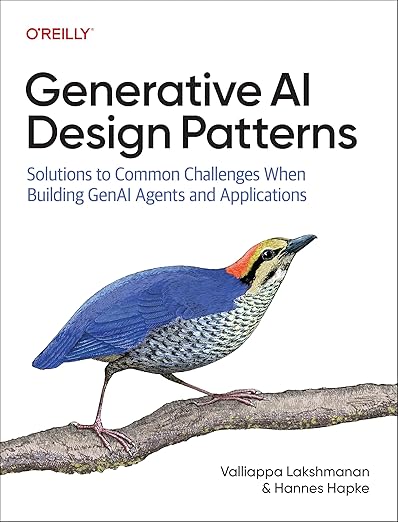
Generative AI Design Patterns
Covers 32 design patterns for generative AI including content control, RAG, reasoning, reliability, and agents. Uses a structured problem/solution format for each pattern.
114 code files (64 .py, 50 .ipynb) — GitHub repo analysis (Nov 2025)
This one is by Lak (Valliappa Lakshmanan), a friend. It is the generative-AI companion to Machine Learning Design Patterns.
Thirty-two patterns, each a problem and its solution. You read the one you need when you hit it, not the book front to back. Three are agent-specific. The rest — RAG, reliability, guardrails, evaluation — are what actually breaks in agent applications.
Chapter 7 covers Tool Calling, Code Execution, and Multi-agent patterns. Broader focus on 32 GenAI patterns including RAG, reasoning, and reliability.
README: 32 patterns, 3 in Ch7 are agent-specific
Pattern #23 covers multi-agent collaboration. Additional supporting patterns include LLM-as-Judge (#17), Reflection (#18), and Long-Term Memory (#28) that enable multi-agent systems.
TOC: Patterns 17, 18, 23, 28
Dedicated example folder for each of 32 patterns. Pattern-focused examples rather than complete applications.
GitHub: 64 .py + 50 .ipynb files
Focus is on backend patterns: content control, retrieval, reasoning, and reliability. Valuable foundation for agent backends.
README TOC review
Read it if you are building generative AI applications broadly and agents are one part of that. Skip it if you want depth on orchestration — it covers multi-agent collaboration in a single pattern.
Building Applications with AI Agents
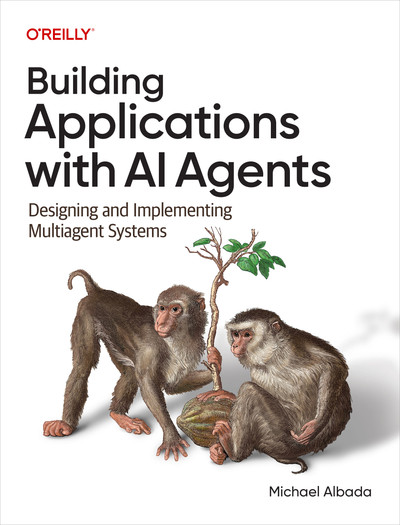
Building Applications with AI Agents
A solid introductory resource for folks new to AI agents. Notably covers human-agent collaboration, trust, and governance (Ch10), plus learning from experience with fine-tuning approaches (Ch6). Includes code samples across 3 frameworks (LangGraph, LangChain, AutoGen)—though these may become outdated given rapid framework evolution.
62 code files (62 .py, 0 .ipynb) — GitHub repo analysis (Nov 2025)
Michael Albada implements the same scenarios across several frameworks rather than picking one and showing its happy path. That comparison is the value: you see what a framework actually costs you on the same problem, which is the question you have when choosing one and the question almost no framework's own documentation answers.
Observability is set up from the beginning rather than bolted on in a final chapter, which matches how you would want to start a real project.
Covers scenario specs, multi-framework implementations, evaluation harness, observability.
README: multi-framework platform for AI agents
Ch7 covers multiagent coordination patterns (democratic, hierarchical, actor-critic), communication protocols, and conflict resolution. Implements across multiple frameworks.
TOC: Ch7 Multiagent Coordination
Multiple scenario-based applications: ecommerce, financial services, healthcare, IT helpdesk, legal, SOC, supply chain.
GitHub: src/frameworks/langgraph_agents/ folders
Ch10 covers human-agent collaboration in depth: roles/autonomy, trust lifecycle, escalation design, oversight, shared memory, governance, and compliance. Production-focused but addresses user-facing concerns.
TOC: Ch10 Human-Agent Collaboration
Read it if you are choosing between frameworks and want the same problem solved four ways rather than one framework's happy path.
Build a Large Language Model (From Scratch)
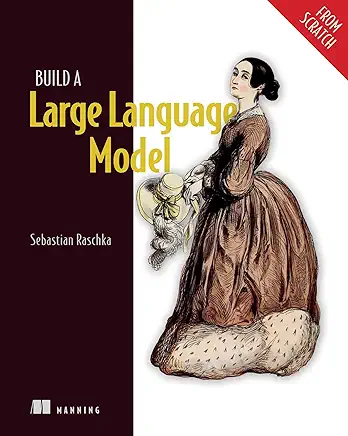
Build a Large Language Model (From Scratch)
Teaches how LLMs work by implementing them from scratch. Covers attention mechanisms, pretraining, and finetuning. Builds a GPT-like model step by step.
177 code files (122 .py, 55 .ipynb) — GitHub repo analysis (Nov 2025)
This scores 1 out of 5 on three of four dimensions and is still on the list. It is not an agent book — it is the book about the layer underneath, and the same is true of the one after it.
Sebastian Raschka has you build a working LLM in PyTorch a piece at a time: tokenisation, attention, the training loop, then fine-tuning. The value is that afterwards the model stops being a black box. When an agent loops, truncates its context or ignores a tool schema, you are debugging a thing you have built rather than guessing at one you have only called.
Focuses on understanding LLMs at the architecture level - essential foundation for understanding what agents call under the hood.
README TOC: Ch1-7 are model building
Focuses on single model training and finetuning. Valuable for teams building custom models for agent systems.
README: no multi-agent topics in TOC
Extensive notebooks building GPT from scratch. Every concept implemented in code.
GitHub: 122 .py + 55 .ipynb files
Focus is on model internals: attention, pretraining, finetuning. Deep understanding helps debug agent behavior.
README TOC review
Read it if you keep hitting the limits of treating the model as a black box. Skip it if you want to ship an agent this quarter.
Build a Reasoning Model (From Scratch)
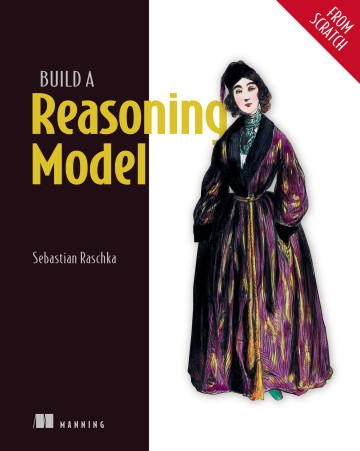
Build a Reasoning Model (From Scratch)
Starts from a pre-trained base model and adds reasoning to it in code: evaluation and answer grading first, then inference-time scaling (temperature and top-p sampling, self-consistency voting), then self-refinement, then training with reinforcement learning from verifiable rewards and GRPO, then distillation. Mirrors how models like DeepSeek R1 are actually built, at a size that runs locally. Eight chapters and seven appendixes; the appendixes cover the Qwen3 source, larger models, batched throughput and a chat interface.
112 code files (93 .py, 19 .ipynb) — GitHub repo analysis (Aug 2026)
Same author, same caveat: not an agent book. You start from a pre-trained base model and add reasoning to it in code — evaluation and answer grading first, then inference-time scaling and self-refinement, then reinforcement learning with verifiable rewards and GRPO, then distillation. It mirrors how models like DeepSeek R1 are trained, at a size that runs on your own machine.
Reasoning is covered in depth — inference-time scaling, self-consistency, self-refinement — and Ch3 builds the answer grading that verifiable rewards depend on. Tools, memory and orchestration are out of scope.
TOC: Ch3-Ch5 reasoning and evaluation; no tool or memory chapters
Single model throughout. No coordination, handoff or orchestration content.
TOC review: 8 chapters, none multi-agent
A working GRPO training loop in reasoning_from_scratch/ch06.py (reward_rlvr, sequence_logprob, compute_grpo_loss, train_rlvr_grpo), with batched and FSDP variants, then Ch7 adds KL, clip ratio and format rewards as separate runnable scripts. CI runs the code on Linux, macOS and Windows.
GitHub: 93 .py + 19 .ipynb, per-chapter modules and test workflows
One appendix builds a chat interface. Otherwise the subject is model internals.
TOC: Appendix on chat interfaces only
Chapter 3 builds answer grading: extraction, normalisation, and symbolic equality checking. Chapter 6 then uses that grader as the reward signal for GRPO training. Scoring an agent trajectory is the same problem, and here you implement both the grader and the training loop that consumes it.
Read it if you want to know how reasoning models are made rather than which one to call. Skip it if you are never going to train one: it assumes PyTorch, and none of it necessarily makes an agent application easier to build.
An Illustrated Guide to AI Agents
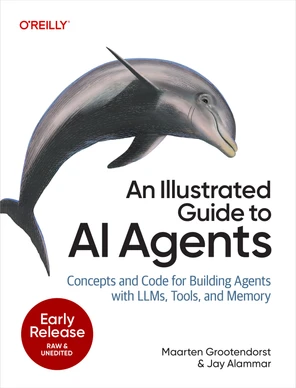
This book is not scored as it is still in development. It is included for the authors' focus on illustration and explanation — they also wrote Hands-On Large Language Models — and it is built around several hundred custom diagrams rather than code listings. Maarten has said there are more than 300 illustrations for the eight finished chapters alone.
Jay Alammar's Illustrated Transformer is how a lot of people first understood attention, and this is that method applied to agents. If you build intuition from a diagram before you build it from a stack trace, this is the one to watch. I will score it here once it ships and the repository is public.
This article included five scored books. I'd say treat this as a starting point rather than a survey. I expect the list will grow. The interactive version, where you can sort by dimension and see every justification side by side, is at multiagentbook.com/labs/ai-agent-books.
Some links on this page are affiliate links.